
Ultrasound-guided barbotage for calcific tendinopathy
Barbotage (needle lavage) is a minimally invasive ultrasound-guided procedure to break up and wash out painful calcium deposits in the rotator cuff and other tendons — a well-established alternative to shoulder surgery for calcific tendinopathy.
Why patients choose GB Clinic
- Targets the underlying calcium deposit — not just symptoms
- Ultrasound-guided from start to finish for accuracy and safety
- Combined with a subacromial steroid injection for rapid pain relief
- Avoids surgery and general anaesthetic in most patients
- Same-day discharge — you can drive home and return to light activity
- Delivered by senior MSK clinicians experienced in image-guided procedures
What to expect
Ultrasound confirms the size, location and consistency of the calcium deposit and rules out other causes.
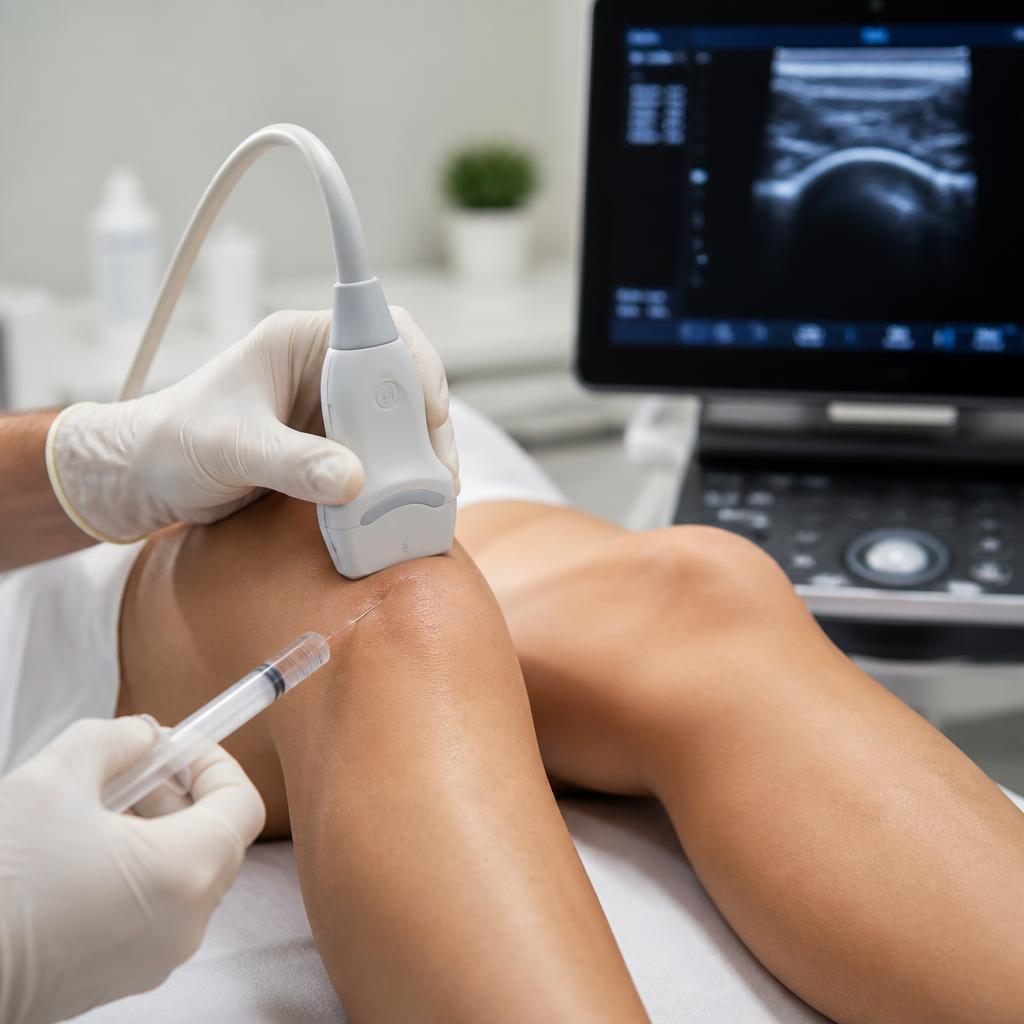
Under local anaesthetic, one or two fine needles are placed into the calcium under ultrasound. Sterile saline is flushed through to soften and aspirate the calcium.
A subacromial steroid injection settles post-procedure inflammation. A structured rehab plan restores movement and strength over 4–8 weeks.
Conditions we treat
How the procedure is performed
- Step 1Ultrasound assessment
Diagnostic scan to confirm calcific deposit within the rotator cuff and to plan the approach.
- Step 2Local anaesthetic
The skin and subacromial space are anaesthetised with lidocaine.
- Step 3Needle barbotage
Under live ultrasound, saline is injected into the calcific deposit and aspirated to break up and wash out calcium.
- Step 4Subacromial injection
A small volume of corticosteroid is placed in the subacromial bursa to reduce post-procedure inflammation.
Recovery timeline
Typical recovery milestones — your clinician will personalise this to your condition, activity level and rehab goals.
Post-procedure ache is common; sling not required — keep the arm gently moving.
Pain typically settles below pre-procedure levels; gentle range-of-motion work continues.
Rotator cuff loading programme; most patients report substantial functional improvement.
Follow-up scan if symptoms persist to check for residual calcium.
Clinical evidence & guidance
Our protocols are informed by recognised clinical guidance and peer-reviewed literature, including:
- de Witte et al. — Ultrasound-guided needling and lavage vs subacromial corticosteroid for calcific tendinitis: RCTAmerican Journal of Sports Medicine, 2013
- ESSR guidelines on musculoskeletal ultrasound-guided interventionsEuropean Society of Musculoskeletal Radiology
- NICE CKS — TendinopathyNICE Clinical Knowledge Summaries
Google Reviews
Trusted by patients across Oxford
Real Google reviews from patients who visited our clinic.
Oxford Injection Clinic is part of GB Clinics, rated 5.0 on Google by patients across Oxford.
Book your appointment today
Barbotage from £550 including diagnostic ultrasound, guided procedure, steroid injection and follow-up.
Ready to speak to a clinician?
Leave your details and our team will call you back the same working day to discuss your symptoms and arrange a suitable appointment.
Prefer to talk now? Call 01865 317483.
Frequently asked questions
Does barbotage hurt?
Local anaesthetic controls sharp pain. Some deep pressure is normal during the lavage. Most patients tolerate the procedure very well and describe it as much less painful than the underlying condition.
How successful is barbotage?
Published studies report 70–90% of patients gain significant, lasting pain relief and functional improvement, often avoiding surgery.
When will I feel better?
Initial soreness for 2–5 days is normal, followed by steady improvement over 4–8 weeks as the tendon settles and the remaining calcium is reabsorbed.
Will I need it repeated?
Most patients only need one procedure. Occasionally a second session is helpful if a large deposit is not fully cleared on the first attempt.
Why patients choose GB Clinic Oxford
Every consultation is led by a senior HCPC-registered musculoskeletal clinician with post-graduate training in diagnostic ultrasound and injection therapy. That matters because the difference between a routine injection and one that genuinely changes your pain is millimetres of accuracy, a correct diagnosis, and a rehabilitation plan tailored to your goals. We invest in high-resolution imaging, single-use sterile consumables and evidence-based protocols so that the care you receive here matches — and often exceeds — what you'd expect from a tertiary NHS or private hospital service.
Because we're an independent MSK specialist clinic — not a general physiotherapy chain — every appointment gives you unhurried time with a decision-maker. There is no fragmented pathway: your scan, diagnosis, injection and rehab plan all happen in a single visit, with a written summary sent to you (and, if you'd like, to your GP or consultant) the same day.
Safety, governance and standards
Our injection therapists work within nationally recognised prescribing frameworks (Patient Group Directions and independent prescribing), and every clinician holds current professional indemnity insurance. We follow infection-control standards set by the Royal College of Radiologists and the Faculty of Sport & Exercise Medicine. Adverse-event rates for image-guided steroid and hyaluronic acid injections in our clinic are consistent with, or below, published international benchmarks.
We are part of the wider GB Clinics group, which brings shared clinical governance, peer review and continuing professional development to every location. If your treatment isn't the right answer we'll say so — and we work closely with orthopaedic surgeons, pain consultants, rheumatologists and radiologists across Oxford, London and the Thames Valley when onward referral is the safer option.
Serving Oxford and the surrounding area
Patients travel to see us from across Oxford — Botley, Summertown, Headington, Cowley, Iffley, Marston, Jericho and central Oxford — and from further afield including Abingdon, Witney, Kidlington, Bicester, Didcot, Wallingford, Wantage, Wheatley, Thame, Woodstock, Chipping Norton, Banbury, Henley-on-Thames and Reading. Free on-site parking, evening appointments and Saturday clinics make it easy to fit an appointment around work or family commitments. If travel is difficult, home visits can be arranged for assessment, follow-up physiotherapy and selected injections across most of Oxfordshire.
Whether you're a runner with a stubborn Achilles problem, a keen gardener whose knee is stopping you enjoying the weekends, or someone who simply wants to walk the dog or lift a grandchild without pain, our aim is the same: an accurate diagnosis, a treatment that has the best chance of working for you, and a clear plan for getting back to the things that matter.
Getting here
Easy to reach — and easy to park
We're in Elms Parade, Botley, just a few minutes from Oxford city centre with excellent transport links.
Free parking
2 hours free, right outside
Park directly in front of the clinic in the Elms Parade car park — 2 hours free for patients, no app or ticket needed for short visits.
From Oxford Railway Station
Approx. 1.5 miles (8 min by taxi, 20 min walk). Head west on Botley Road, continue straight across the A34 flyover into Westway, then turn right into Elms Parade.
Nearest bus stop
Elms Parade (Stop B1) — directly outside the clinic. Served by routes 4, 4A, 4B and 4C from Oxford city centre (every 10–15 min).
By car
Junction 8/9 of the A34, exit toward Botley. Postcode OX2 9LG for sat-nav.