
Platelet-Rich Plasma (PRP) injections in Oxford
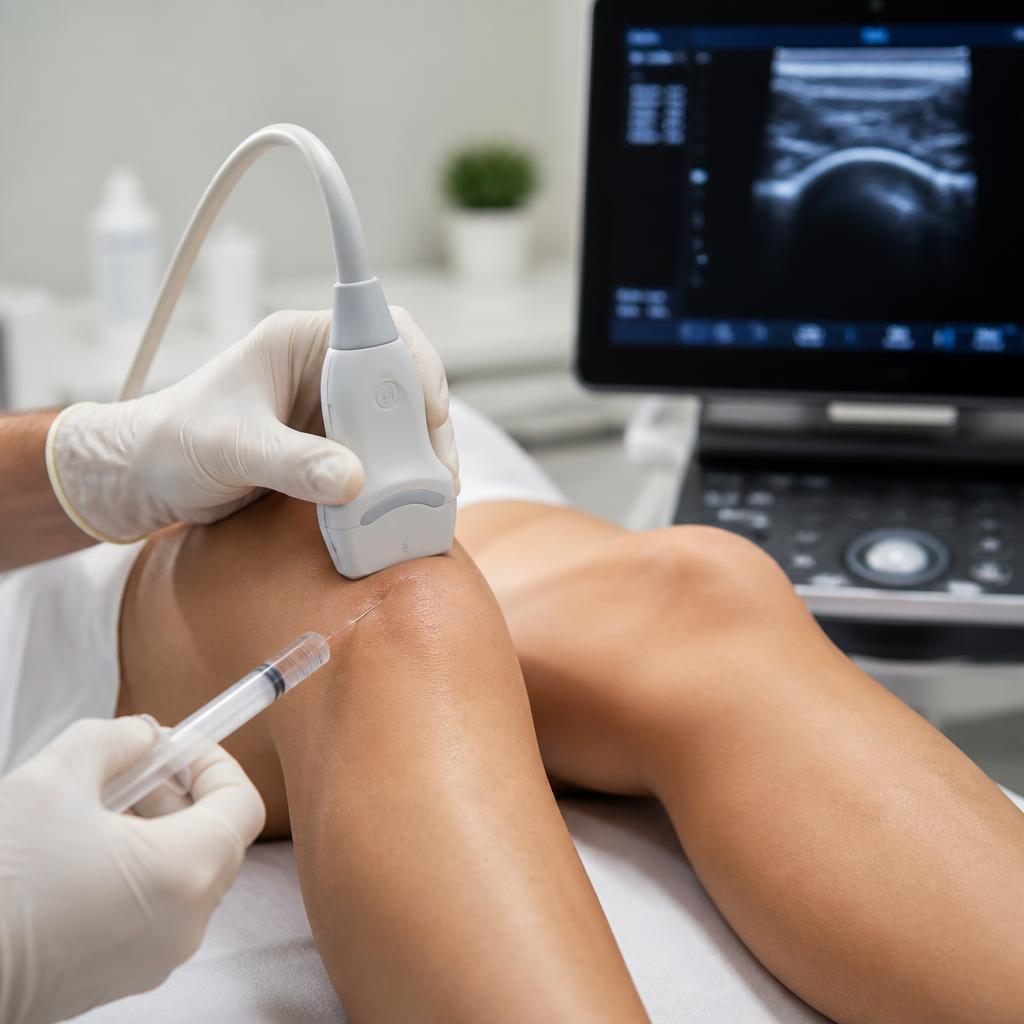
Ultrasound-guided PRP therapy uses a concentrated preparation of your own platelets to stimulate healing in tendons, ligaments and early-stage joint arthritis — a drug-free, regenerative alternative when rest, physio or steroid have not resolved the problem.
Why patients choose GB Clinic
- Uses your own blood — no steroids, no synthetic drugs, minimal allergy risk
- Delivered under live ultrasound guidance for pinpoint accuracy
- Stimulates collagen production and true tissue healing, not just symptom relief
- Supported by growing evidence for tennis elbow, patellar & Achilles tendinopathy and mild knee OA
- Ideal when steroid injections are contraindicated or have stopped working
- Delivered by HCPC-registered senior MSK clinicians alongside a tailored rehab plan
What to expect
Full clinical assessment and ultrasound scan to confirm PRP is appropriate for your tissue and stage of injury.
A small sample of blood is drawn from your arm and spun in a centrifuge to concentrate the platelets — around 15 minutes in clinic.
The PRP is injected directly into the target tendon or joint under live ultrasound. A structured rehab programme follows to maximise the response.
Conditions we treat
How the procedure is performed
- Step 1Assessment & scan
Ultrasound assessment of the target tendon or joint to confirm PRP is appropriate for the tissue and stage of injury.
- Step 2Blood draw
A small sample of blood is drawn from the arm and placed in a licensed PRP kit.
- Step 3Centrifugation
The sample is centrifuged for around 10–15 minutes to concentrate platelets and growth factors.
- Step 4Ultrasound-guided injection
The prepared PRP is injected into the target tissue under live ultrasound.
- Step 5Rehab plan
A structured graded loading programme is issued to maximise the biological response.
Recovery timeline
Typical recovery milestones — your clinician will personalise this to your condition, activity level and rehab goals.
Expected post-injection flare; use paracetamol only — avoid anti-inflammatories.
Return to light daily activity; begin the prescribed isometric loading exercises.
Progressive loading; most patients report early symptom improvement.
Peak tendon remodelling; assess response and decide on any repeat injection.
Clinical evidence & guidance
Our protocols are informed by recognised clinical guidance and peer-reviewed literature, including:
- NICE CKS — TendinopathyNICE Clinical Knowledge Summaries
- Filardo et al. — PRP in musculoskeletal disorders: evidence-based recommendationsKnee Surgery, Sports Traumatology, Arthroscopy, 2021
- ESSR guidelines on musculoskeletal ultrasound-guided interventionsEuropean Society of Musculoskeletal Radiology
Google Reviews
Trusted by patients across Oxford
Real Google reviews from patients who visited our clinic.
Oxford Injection Clinic is part of GB Clinics, rated 5.0 on Google by patients across Oxford.
Book your appointment today
PRP injections from £550 including consultation, ultrasound scan, PRP preparation and follow-up review.
Ready to speak to a clinician?
Leave your details and our team will call you back the same working day to discuss your symptoms and arrange a suitable appointment.
Prefer to talk now? Call 01865 317483.
Frequently asked questions
How many PRP injections will I need?
Most tendon conditions respond to a course of 1–3 injections spaced 4–6 weeks apart. We review response before recommending further sessions.
Is PRP painful?
The blood draw feels like a routine blood test. The injection itself can feel firm because PRP has a thicker consistency, but discomfort is short-lived and settles within 24–72 hours.
When will I feel improvement?
PRP works by stimulating healing, so change is gradual. Most patients notice improvement from 4–6 weeks, with continued gains up to 3–6 months post-injection.
Are there restrictions after PRP?
Avoid anti-inflammatories for 2 weeks before and after the injection, and follow the graded loading programme we set. Light activity is fine the same day.
Why patients choose GB Clinic Oxford
Every consultation is led by a senior HCPC-registered musculoskeletal clinician with post-graduate training in diagnostic ultrasound and injection therapy. That matters because the difference between a routine injection and one that genuinely changes your pain is millimetres of accuracy, a correct diagnosis, and a rehabilitation plan tailored to your goals. We invest in high-resolution imaging, single-use sterile consumables and evidence-based protocols so that the care you receive here matches — and often exceeds — what you'd expect from a tertiary NHS or private hospital service.
Because we're an independent MSK specialist clinic — not a general physiotherapy chain — every appointment gives you unhurried time with a decision-maker. There is no fragmented pathway: your scan, diagnosis, injection and rehab plan all happen in a single visit, with a written summary sent to you (and, if you'd like, to your GP or consultant) the same day.
Safety, governance and standards
Our injection therapists work within nationally recognised prescribing frameworks (Patient Group Directions and independent prescribing), and every clinician holds current professional indemnity insurance. We follow infection-control standards set by the Royal College of Radiologists and the Faculty of Sport & Exercise Medicine. Adverse-event rates for image-guided steroid and hyaluronic acid injections in our clinic are consistent with, or below, published international benchmarks.
We are part of the wider GB Clinics group, which brings shared clinical governance, peer review and continuing professional development to every location. If your treatment isn't the right answer we'll say so — and we work closely with orthopaedic surgeons, pain consultants, rheumatologists and radiologists across Oxford, London and the Thames Valley when onward referral is the safer option.
Serving Oxford and the surrounding area
Patients travel to see us from across Oxford — Botley, Summertown, Headington, Cowley, Iffley, Marston, Jericho and central Oxford — and from further afield including Abingdon, Witney, Kidlington, Bicester, Didcot, Wallingford, Wantage, Wheatley, Thame, Woodstock, Chipping Norton, Banbury, Henley-on-Thames and Reading. Free on-site parking, evening appointments and Saturday clinics make it easy to fit an appointment around work or family commitments. If travel is difficult, home visits can be arranged for assessment, follow-up physiotherapy and selected injections across most of Oxfordshire.
Whether you're a runner with a stubborn Achilles problem, a keen gardener whose knee is stopping you enjoying the weekends, or someone who simply wants to walk the dog or lift a grandchild without pain, our aim is the same: an accurate diagnosis, a treatment that has the best chance of working for you, and a clear plan for getting back to the things that matter.
Getting here
Easy to reach — and easy to park
We're in Elms Parade, Botley, just a few minutes from Oxford city centre with excellent transport links.
Free parking
2 hours free, right outside
Park directly in front of the clinic in the Elms Parade car park — 2 hours free for patients, no app or ticket needed for short visits.
From Oxford Railway Station
Approx. 1.5 miles (8 min by taxi, 20 min walk). Head west on Botley Road, continue straight across the A34 flyover into Westway, then turn right into Elms Parade.
Nearest bus stop
Elms Parade (Stop B1) — directly outside the clinic. Served by routes 4, 4A, 4B and 4C from Oxford city centre (every 10–15 min).
By car
Junction 8/9 of the A34, exit toward Botley. Postcode OX2 9LG for sat-nav.